Bus Stop looks beyond the percentage for local supply

Local content matters, but Bus Stop’s Pete White says the real test is what remains after delivery: reliable buses, whole-of-life support and skilled people
Local content has become a central topic in Australasia’s bus and coach industry, but ask three people what it means and the answers may differ. Is it a bus made here from local parts? An imported pack assembled in Australia? Or a locally completed vehicle that combines overseas technology with Australian labour and components?
Those questions matter as governments, operators and manufacturers plan the next phase of heavy-vehicle production. For Bus Stop Sales managing director Pete White, local content is valuable when it combines proven global technology with Australian capability and delivers a better outcome for the operator.
White remembers standing at the Warwick Farm bus show in Sydney in the 1990s, looking at American MCI coaches displayed in left-hand drive.
“They were impressive vehicles, but simply moving a product from left-hand drive to right-hand drive does not make it right for Australia,” he told ABC.
“You still have to listen to operators here and adapt the vehicle, local content and whole-of-life support around how they actually work.”
The easiest fleet replacement is usually like for like: a known product, familiar parts and an established support path. But in some categories, the badge may be the same while the bus underneath has changed significantly, whether in size, configuration, driveline or supply chain. At that point, staying with the same brand is no longer a true like-for-like decision, and the operator has to look across the market for the best fit.
Other challenges are arriving just as quickly. Introducing a zero-emission bus into a depot built around diesel, meeting growing passenger demand without moving beyond an LR licence, meeting government local-content requirements or keeping a regional vehicle supported hundreds of kilometres from a capital city.
At Bus Stop, the starting point is that each challenge may require a different answer because no two operators face exactly the same commercial and operational pressures. What has not changed, according to White, is the need for good old-fashioned support and parts availability. Whatever technology sits underneath the vehicle, operators still need knowledgeable people who answer the phone, parts on the shelf and practical help when a bus is off the road.
“We need enough range to solve the first problem, then the parts, training, technical knowledge and support to keep the bus doing its job over its life,” he says.
White is commercially wired to look for an answer, but he is also realistic about what it takes to deliver one – engineering, compliance and product development take time. More money can open more options, but it does not remove the need to make sensible choices.
“We have learnt that every decision gives something and takes something away,” he says.
“Increasing passenger capacity adds weight, while GVM, axle loads and seating layout determine the final usable seat count. Electric batteries add another significant weight challenge. If the industry is expected to deliver a genuine 57-seat zero-emission school bus, regulators also need to review current GVM settings.
“When seatbelts were introduced, a two-tonne uplift recognised the additional weight – the transition to electric vehicles requires the same practical approach. Depending on the design, scale and capability available, more local content can also add cost or extend delivery while a new integration pathway is established.
“Customisation may solve today’s requirement but add complexity for the next 15 years. The best answers come when operators, engineers, manufacturers and maintainers sit around the same problem. A useful partner is honest about the trade-offs.”
This is not a Bus Stop argument alone. Industry leaders have recently called for procurement to recognise the Australian economic value created over a vehicle’s full life, not only where final assembly occurs. This argument points to local jobs, suppliers, training, engineering, maintenance, investment, taxation, parts and whole-of-life support. This position remains strongly supportive of genuine Australian manufacturing, but clear that policy should be judged on ‘outcomes, not optics’.
“Operators want to support Australian content and the businesses and jobs it creates wherever it makes practical and commercial sense,” White says.
- Subscribe to our free weekly newsletter to receive the latest news and classifieds from Australasia’s bus and coach industry.
- Don’t miss a second and subscribe to our monthly ABC magazine
“But a bus is also a working asset, and local content cannot come at the expense of suitability, reliability or whole-of-life value.
“The bus still has to be reliable, suit the route, work for drivers and passengers, arrive when promised and earn its keep. That becomes even more important as the industry moves from individual trials to transition at scale.”
That is where a proven international platform, combined with Australian integration, components and support, can deliver better value over the vehicle’s life rather than simply the lowest purchase price.
“An operator with enough capital to replace 10 ageing buses may find that the vehicle premium, charging, depot works and training reduce the same program to six or seven zero-emission buses,” White says.
“The other buses do not disappear. Neither do the services, maintenance bills or passengers relying on them.”
White strongly supports Australian manufacturing but says local content must work in practice. It should create lasting jobs and skills without making buses too expensive, unsuitable for the job or difficult to keep on the road.
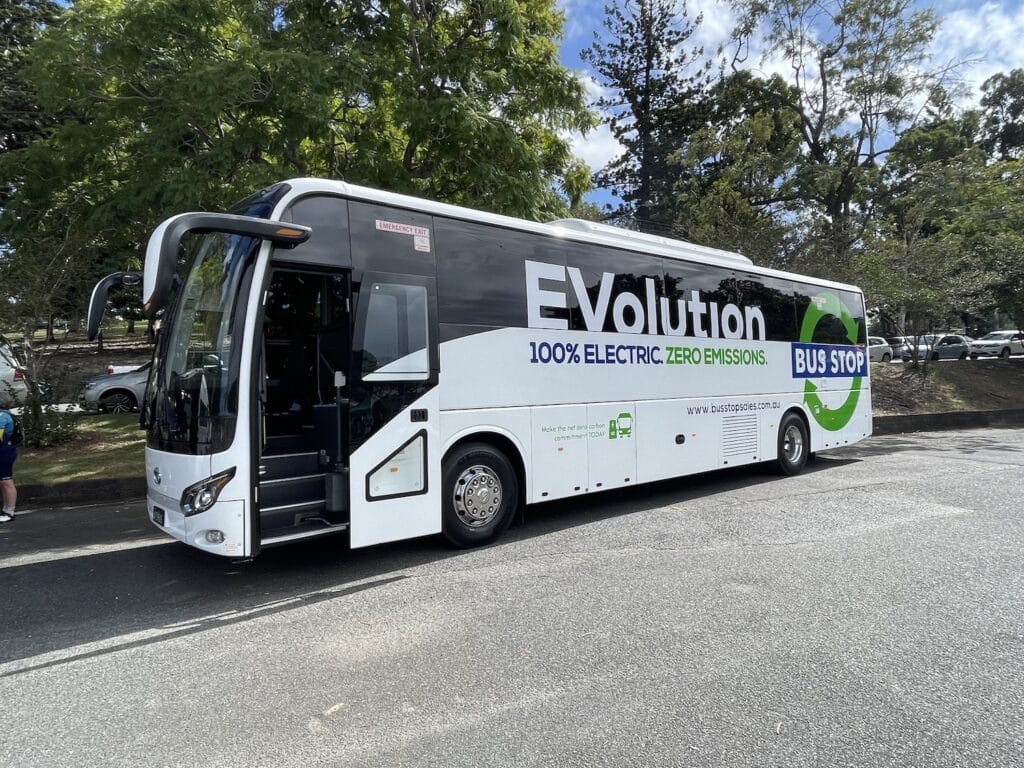
Bus Stop is family-owned, but White expects it to carry the product, technical, warranty and lifecycle responsibilities of an OEM-level supplier. That also means remaining profitable. Without a strong Australian business, there is no long-term reinvestment, employment or fleet support. White wants more of that value to remain onshore through wages, apprenticeships, facilities, engineering, parts and service.
Government procurement can help turn local-content ambition into lasting capability by giving the supply chain a clearer view of future demand. Greater transparency would also build trust and give businesses more confidence to invest locally.
“A manufacturer cannot responsibly expand, buy equipment or employ apprentices on the possibility of another order,” White says.
“Credible volume, consistent rules and realistic timing give businesses the confidence to invest.
“The workforce pressure is shared – operators need drivers and mechanics, while manufacturers are competing for welders, engineers, technicians and people with high-voltage skills.”
That pressure has influenced Bus Stop’s latest product work. The King Long EVolution2 is designed as a modular platform, allowing the operator, body builder, OEM and specialist suppliers to decide where work is best carried out and what level of local content is realistic for the skills, capacity and timetable available.
Bus Stop is also trying to grow more capability from within. Its apprenticeship pathways have included school-based entrants, Indigenous Australians and mature-age workers progressing towards qualified roles. White says the aim is to build a team with momentum, ownership and the professional standards expected of an OEM-level supplier. The broader mix of people also widens the industry’s talent pool and creates careers that can last beyond a single contract.
“Our EV Training Centre was never intended to promote one company or one brand,” he says.
“Its first purpose is to keep people safe as high-voltage vehicles become part of everyday fleet operation.”
The centre develops practical safety and diagnostic capability for manufacturers, operators, technicians, depot teams and emergency responders.
“My view is simple: a rising tide lifts all boats,” White says.
“The transition will work only if the industry builds capability together.”
He points to Bus Stop’s 40,000-square-metre Rocklea site, which has room for expanded assembly or manufacturing when sustainable demand supports it, as an example. The company has also provided BusTech with space there for the past three years. White believes Australia needs a healthy and competitive bus industry, with several capable suppliers working alongside operators and the local supply chain. The scale and variety of the fleet transition cannot be met by one dominant company without risking choice, capacity and long-term resilience.
For now, White sees the strongest opportunity in a deeper network of specialist Australian SMEs contributing to mid-build assembly, body integration, electrical work, interiors, accessibility, commissioning and support. He wants that participation to move further upstream as skills, volume and order certainty grow.
Bus Stop’s range shows how the approach works in practice. White grew up around Australian bus building and later helped bring international brands into this market. The lesson he draws from both is straightforward: use global scale where it adds value, then build Australian capability and support around it.
On relevant diesel models, Bus Stop has accepted a higher upfront cost to specify recognised systems such as ZF independent front suspension and axle technology. ZF’s Australian aftermarket network gives operators access to parts and support through established service partners and resellers. White acknowledges that, at the value end of the market, the lowest purchase price can be difficult to look past, but a cheaper component at delivery may not remain the better-value decision over the life of the bus. Operators can also localise seating, air-conditioning, accessibility equipment, CCTV, electrical systems and completion work where the supplier, parts pathway and warranty responsibility are clear.
The I-Bus partnership responds to a different operator problem: adding passenger capacity without moving beyond an LR licence.
“The NQR carries 31 passengers plus the driver while retaining an LR-licence option on a Japanese-made Isuzu chassis,” White says.
“Comparable LR-licence buses carry between 21 and 27 passengers, giving the I-Bus between four and 10 additional passenger seats. That extra capacity can make a meaningful difference without requiring a driver with a higher licence class.
“Some buyers have traditionally operated other brands, only to find that a genuine like-for-like replacement is no longer available in Euro 6 or that the current model uses a substantially different driveline. This has led operators to look beyond the familiar badge and decide which product now offers the best combination of capacity, simplicity and support.”
The King Long range covers the nine- and 10-metre midi segment, sitting between minibuses and full-size coaches, as well as 12-metre school, charter and coach applications. A lower-volume 13-metre option remains available where additional passenger or luggage capacity improves the route economics. White says supporting a genuine, if smaller, part of the market is also part of being a solutions partner.
The same thinking is visible with the EVolution2, which Bus Stop regards as King Long’s most advanced zero-emission platform yet. It is fully integrated and modular, with room to increase Australian content as capability and volume grow. The core chassis can take an Australian or New Zealand-built body, with local engineering, interiors, accessibility systems, electrical integration, commissioning and completion added as capability develops. Options include a Global Bus Ventures body from New Zealand or a Volgren body built in Australia, while a complete imported-body pathway remains available when the application calls for it.
“EVolution2 is next generation, but it does not begin at zero,” White says.
“Its battery integration, thermal management, controls, driveline and safety architecture draw on lessons from more than 100,000 King Long electric vehicles operating internationally. Local trials remain essential for Australian roads, heat, depots and duty cycles, but they should refine a mature platform rather than ask an operator’s revenue fleet to uncover basic weaknesses.”
White says he would welcome a viable Australian battery solution, but the difficulty is that the cells, battery-management software, thermal control, charging, vehicle controls and diagnostics must work as one system. For its current production requirements, Bus Stop hasn’t identified a complete domestic solution with the scale and operating history available internationally. Its position is to use proven technology now while supporting Australian capability to keep developing.
For White, that’s the value of a global partnership – engineering tested at scale, combined with Australian and New Zealand bodies, components, skills and support. King Long EVolution chassis with Global Bus Ventures bodies are already operating on Kinetic’s SkyBus service in Melbourne with substantial Australasian body-build content, with those lessons feeding into the EVolution2.
“Partnership matters most when something goes wrong,” White says.
“Every contract, from one regional bus to a major fleet program, carries direct and indirect costs through capital, delay, downtime and management time. A bus can involve the chassis maker, body builder, electrical, charging and software suppliers and local installers.”
When Bus Stop is the prime contractor, often through its role as chassis supplier, White accepts that his group must coordinate those parties and return the vehicle to service. The operator should not be left carrying the gaps. White wants local content that can be pointed to in the vehicle, the workforce and the supply chain: assembly, engineering, components, skills and ongoing support. In his view, a percentage created mainly through accounting treatment does little for government, operators or suppliers making genuine investments.
The same practical test applies to zero-emissions models. In his view, local completion delivers its full value only when grid capacity, chargers, depot power, route planning, training and emergency procedures are ready with the bus. Brisbane 2032 is an important milestone, but the lasting measure will be a stronger transport system and local capability serving Queensland well beyond the event.
White has taken responsibility for brands with histories that predate Bus Stop. For him, respecting that legacy means improving the products and support to meet today’s market and where operators want to go next. The company’s developing ‘control tower’ brings technical support, parts, warranty and field feedback into one place so lessons from service lead to the next improvement. The real test comes later – is the bus available, did the apprentices qualify, is the supplier still operating and did the operator have enough confidence to order again?
“Meaningful local content is the value that remains after delivery: skilled people, stronger Australian suppliers and reliable buses that operators can afford to keep in service,” White says.
“Our responsibility is to bring those pieces together, stand behind the complete vehicle and keep building capability for the next order, not only this one.”